We foster strong partnerships with our clients while focusing on results by providing customized, simple, and practical solutions
We identify, in a clear and prioritized way, the set of organizational and technological improvements required to establish efficient and coherent management
We foster strong partnerships with our clients while focusing on results by providing customized, simple, and practical solutions
We identify, in a clear and prioritized way, the set of organizational and technological improvements required to establish efficient and coherent management
Artificial intelligence (AI) is expanding rapidly across organizations. The rise of generative models, virtual assistants, and intelligent automation has created widespread enthusiasm across technology and business. But that momentum also carries a clear risk: adopting AI because it is fashionable rather than because it solves a real need. In many organizations, AI has been introduced too quickly, without enough consideration of the value it creates, who benefits, or how it can integrate without disrupting existing systems.
Not every process needs AI, and not every task should be automated. The key is not to apply AI wherever possible, but where it is genuinely useful and can operate without creating friction. This is the premise behind Transparent AI, developed by Francesc Xavier Berjano: a silent, contextual, and non-intrusive approach to integrating AI into everyday operations. The principle is simple: AI does not need to be visible; it needs to be useful.
Transparent AI represents a shift in perspective. Instead of requiring people to adapt to new systems or complex AI interfaces, it turns the relationship around: AI adapts to people, existing workflows, and organizational culture. It intervenes when relevant, stays in the background, and delivers tangible value. It does not impose dashboards, require additional training, or disrupt user-facing processes. It simply acts when it can help.
A new way to integrate AI into the organization: invisible, contextual, and focused on real outcomes. No new tools to learn, no added friction, and no disruption to existing workflows.
But there’s something more important to answer first:
How do we integrate AI without disrupting people’s work?
Many organizations have already adopted AI tools. Yet many of these solutions still require people to switch context, learn new interfaces, or interrupt their workflow before they can benefit from them.
The result is often limited adoption, fragmented workflows, and benefits that are difficult to scale.
Transparent AI starts from a different premise:
Artificial intelligence (AI) is reshaping how we work, but adoption often brings complexity, friction, and resistance. Transparent AI — proposed by Francesc Xavier Berjano — offers a different model: AI integrated invisibly and quietly, aligned with the natural flow of work.
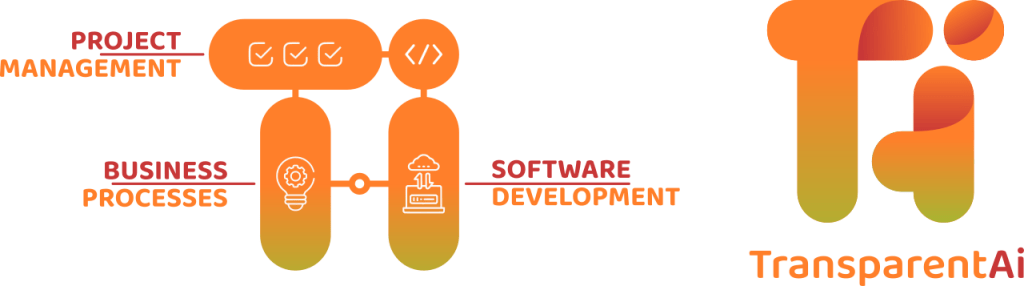
Identifies inefficiencies, automates repetitive tasks, and optimizes operational workflows without disrupting the way teams work.
Supports technical teams throughout the entire software lifecycle: coding, testing, review, security, and continuous integration.
Anticipates blockers, summarizes progress, identifies risks, and improves team coordination without adding bureaucracy to the process.
Transparent AI is not designed to replace people or impose a new platform. It acts as contextual intelligence that works with existing processes and delivers value over time.
Works in the background without disrupting operational workflows.
Understands the work environment and acts according to the moment, the process, and real needs.
Doesn't force changes in habits or dependence on a new centralized interface.
Integrates in phases, without redesigning the entire organization from scratch.
Learns from historical behavior and enables process optimization over time.
Each Transparent AI module is designed to integrate into existing workflows without causing disruption.
Result: More efficient processes, less operational load, and greater adaptability.
Result: Higher productivity, fewer interruptions, and better software quality.
Result: More focused teams, faster decisions, and less dependence on manual tracking.
Five tangible impacts for teams that want to move forward with AI without increasing complexity.
AI integrates into existing workflows, reducing the need to switch context.
Users do not need to prompt AI constantly; it acts when it identifies a meaningful opportunity to help.
Especially in processes, software, and project management, where traceability is key.
Because it is invisible and non-intrusive, it reduces the cultural and technical barriers that often slow AI adoption.
It can be deployed modularly and scaled as each organization's needs evolve.
An AI layer designed to increase operational capacity without adding technological complexity.
Transparent AI is designed for organizations that understand AI’s potential and now need to translate it into measurable operational impact.
“AI shouldn’t be an interruption. It should be a silent capability of the organization.”
The full paper develops Transparent AI as a discreet, contextual, and modular approach to enterprise AI. Instead of forcing people to adapt to technology, Transparent AI proposes that technology adapt to the natural flow of work.
Access the full paper and explore the Transparent AI model in depth: an approach to integrating AI into your organization without adding friction.
Complete the form to access the full paper on the vision, principles, and applications of Transparent AI.
If you would like to explore how Transparent AI could apply to your organization before reading the paper, request an introductory diagnostic session with our team. No commitment required.
Implementing AI without the right integration model can create more complexity than value. Transparent AI works in the background so your teams can perform better in the foreground.
“The future of enterprise AI doesn’t lie in the most visible interface, but in the most useful capability.”